School zones (children's protection zones) in Korea
Around elementary schools, kindergartens and daycare centers you will see red road paint and signs saying 어린이 보호구역. These zones have the strictest rules on Korean roads, and fines and penalty points are higher than on normal roads.
How to recognize a school zone
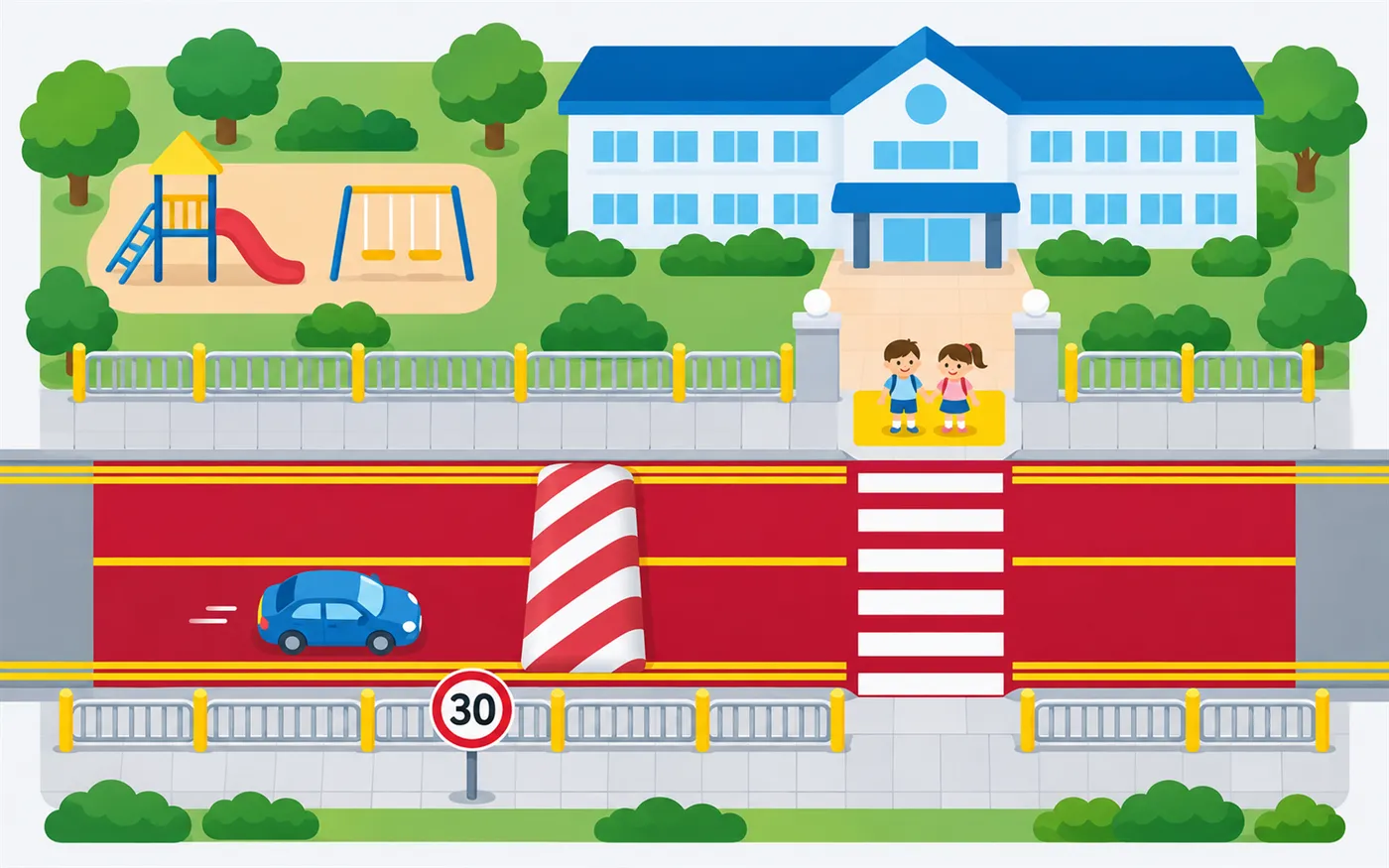
- Red-painted road surface, yellow or white "어린이 보호구역" signs, and often yellow footprints at crosswalks.
- Fixed speed cameras are common at the start of the zone and near crosswalks.
Speed limit
- The usual limit is 30 km/h. Some streets are even slower; follow the sign.
- Since 2023 some zones use time-based limits: 30 km/h when children are around, and a higher limit (often 40 or 50 km/h) at night. The sign shows the hours. If you are not sure, drive at 30 km/h.
No parking or stopping
- Parking and stopping are banned in school zones, especially from 8 a.m. to 8 p.m.
- The fine for a passenger car is up to 120,000 won, about three times the normal amount.
School buses
- When a yellow children's school bus stops with its red lights flashing, cars in the same lane and the lane next to it must stop, then pass slowly after checking.
- On a road with one lane each way, cars coming the other way must also slow down and stop.
- Never pass a school bus that is moving with its lights flashing.
If a child is hurt (the Minsik law)
Since March 2020, injuring or killing a child under 13 in a school zone through a speeding or safe-driving violation brings heavy criminal penalties: from 1 to 15 years in prison or a fine of 5 to 30 million won for an injury, and life imprisonment or at least 3 years in prison for a death.
Safe habits
- Slow down before the red paint starts, not when you see the camera.
- Children run out between parked cars. Watch both sides of the road.
- Stop fully before turning right at a school-zone crosswalk. See right-turn rules.
Sources: Road Traffic Act and Act on the Aggravated Punishment of Specific Crimes (Article 5-13); Seoul Metropolitan Government notice on school-zone parking fines (May 2021). Some cities set different hours and limits, so always follow the signs. Checked November 2026.